
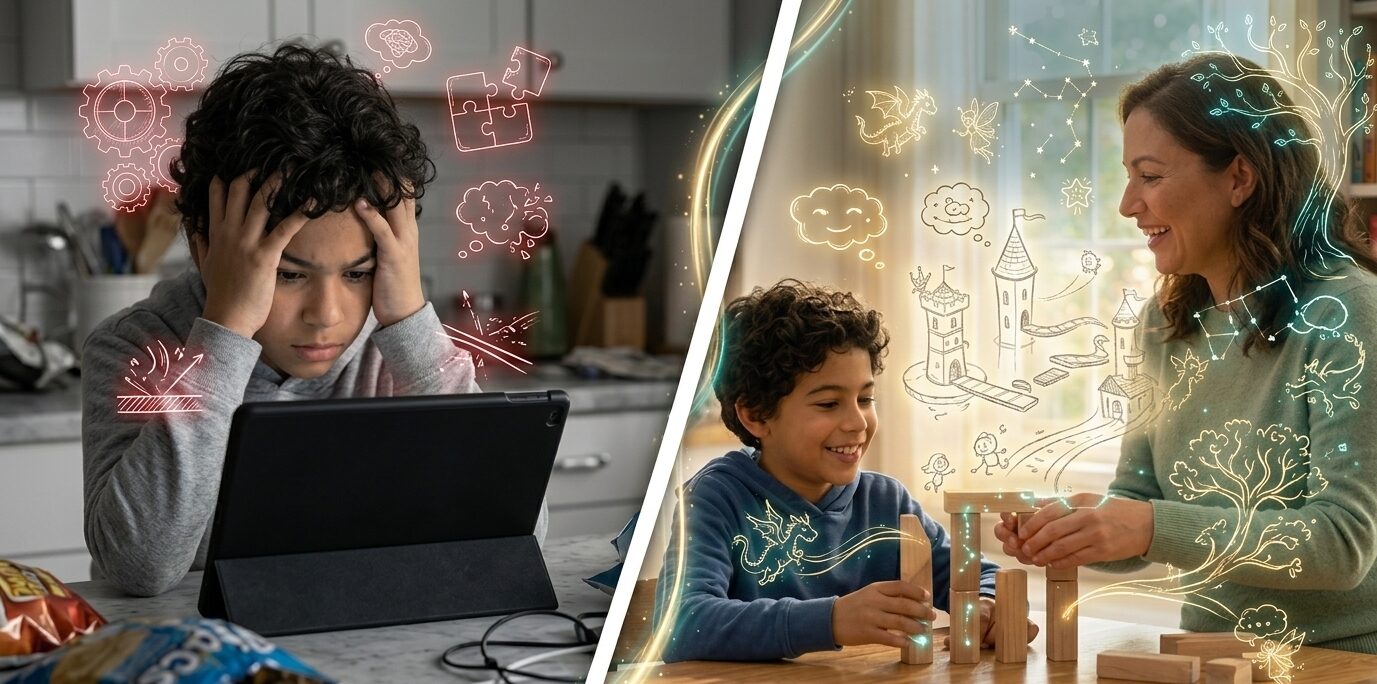
Stopping screen time meltdowns is easily one of the most exhausting daily battles families face at home. For more than ten years, my work has lived between two worlds: game development and education. Most of my career has been spent designing skill-development games for universities and companies. But when my studio built our game, Muffin Fight, we stepped into a completely different space: figuring out how game design can help younger kids practice real-life social-emotional skills.
When you design games for a living, your entire job is to study how people interact with a system and find exactly where the user experience breaks. And looking at the daily tug-of-war happening in living rooms, it’s clear that a system is breaking for families.
Recently, I was chatting with a few parents about how their kids interact with digital games. I was sharing my favorite ideas about play-based learning when one mom stopped me and reminding me there’s a great difference between theory and practice.
“How am I supposed to teach my kid resilience when I’m just trying to end their screentime without a screaming match?”
Nothing like a tired parent to keep you grounded. She was totally right. For most families, stopping screen time meltdowns is the ultimate frontline challenge.
What Happens When Screen Time Ends
When a child experiences a massive behavioral crash at the end of a gaming session, we often treat it as a discipline issue. But as a designer, I see it as a structural breakdown. The transition moment is simply too emotionally expensive for their nervous system to handle alone.
Mainstream digital entertainment actively triggers these post-play tantrums using three invisible design mechanics:
- Infinite Loop Traps: Modern apps use autoplay and endless scrolls that purposely have zero natural stopping points to trap attention. Forcing a child to break focus abruptly leaves them entirely unequipped to regulate their emotions.
- Passive Noise Exhaustion: Many games act as “digital babysitting,” relying on fast-paced novelty. This overstimulates a child’s brain, leaving them drained and highly sensitive to friction the moment the screen is turned off.
- Isolation Barrier: Most digital spaces isolate the player. When a child is left navigating these intense virtual worlds completely alone, returning to the physical reality of family life feels incredibly jarring and stressful.
Two Game Design Fixes for Stopping Screen Time Meltdowns
Stopping screen time meltdowns isn’t about finding the perfect disciplinary consequence. It is about changing the emotional cost of shifting gears. As a game designer, I look at how we can rebuild the home routine using the same engagement principles that make games work—shifting from friction to connection.
Here are two practical ways to apply play design to your daily routine tonight:
1. Build an “Episodic Save Point”
Instead of ending a game strictly by the kitchen timer, which completely ignores where the child is inside the game’s loop, anchor the transition to a logical narrative milestone.
Agree beforehand that the screen turns off when they finish a specific level, complete one quest, or reach a specific “save point.”
This respects the player’s psychology, allowing them to close the loop mentally, which dramatically reduces the emotional friction of shutting down.
2. Introduce a “Bridge Interaction”
Don’t force your child to jump straight from a high-stimulus digital world into a low-stimulus chore, dinner or bedtime. That sudden drop-off is where systems break. Instead, create a short, physical transition bridge.
When the screen turns off, ask them to tell you the story of what just happened in their game, or use a tactile toy like building blocks to recreate a structure they just saw on screen. This intentional interaction acts as a physical decompression chamber, lowering the nervous system’s stimulation level slowly while keeping the parent-child connection intact.
When we stop viewing play as a dangerous distraction and start seeing it as a space where children are actively trying to navigate challenge, failure, and transitions, everything changes. We can move away from rigid time-police battles and focus on building low-cost, gentle systems for re-entry.
You don’t need a complex strategy to start changing how your child handles frustration. You just need a new pair of eyes to spot the emotional mechanics already at play right in front of you.
See the Learning Hidden in Everyday Play
If you want to start spotting the hidden real-life skills your child is practicing during everyday play, and learn how to lower the emotional cost of daily transitions, grab our free Parents’ Quick Guide.
Inside, we share simple, practical ways to notice resilience, focus, and emotional safety in your child’s everyday routines, no worksheets or pressure required.