The Moment Before Play
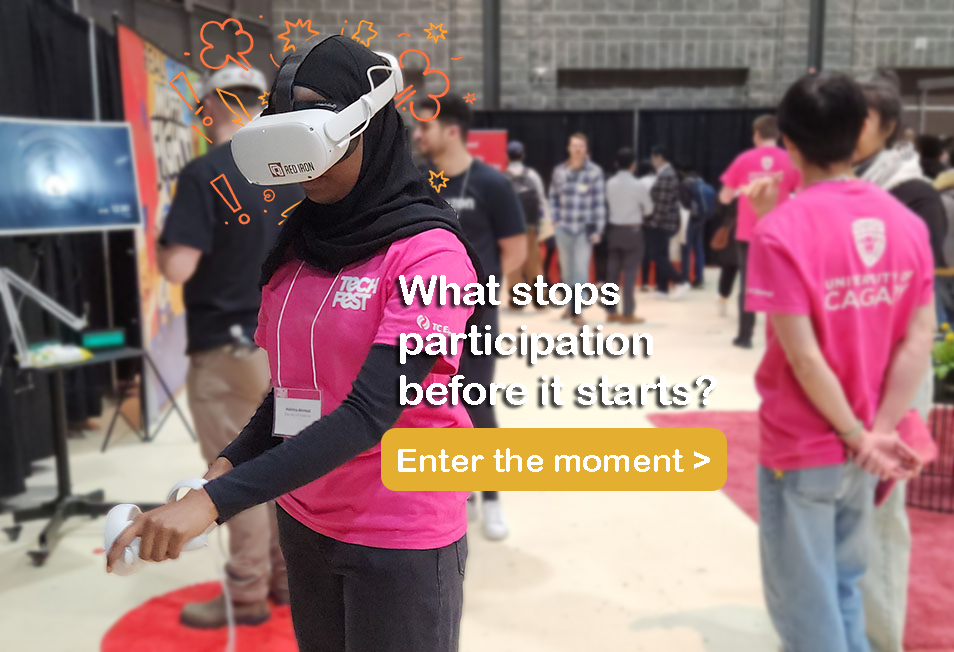
At a university tech festival, Fatima—a 19-year-old volunteer—was surrounded by employers, recruiters, and innovation leaders.
She was exactly where young adults are told they should be.
And yet, she hesitated.
“I don’t want to look dumb in front of them”, she confided to me.
This wasn’t a lack of ability.
It was the same hesitation most of us feel when we’re told to “just network”—only with higher stakes and less experience to lean on.
Uncertainty.
Self-consciousness.
Fear of public failure.
This is where learning either shuts down—or begins.
The Learning Loop at Work
At Third Bell Studio, we study how learning unfolds in the moment, not just in outcomes.
When Fatima was invited to play a short round of a collaborative game, her hesitation surfaced immediately. Her body language changed. She verbalized doubt. She weighed the social risk.
This is the threshold before participation:
Uncertainty → Hesitation → Choice
What mattered wasn’t the game itself—it was what the experience allowed her nervous system to feel:
- a clear goal
- low stakes
- immediate feedback
- social safety
Within minutes, her posture softened. She laughed. She adapted. She took initiative.
The participation loop took over:
Uncertainty → Try → Feedback → Adjust → Re-Entry
What Changed After Play
After the game ended, something subtle but important shifted.
Fatima began approaching employers—using her role as a volunteer to start conversations. Not perfectly. Not with rehearsed confidence.
But willingly.
The pressure had already dropped, so the conversation no longer felt like a performance.
She didn’t become “confident” overnight.
She practiced self-advocacy once—safely.
And that was enough to make participation feel possible again.
Why This Matters
We often treat social-emotional skills as things that must be taught explicitly.
In practice, they are learned through experience.
Play creates conditions where learners can:
- take emotional risks
- recover from small failures
- experience agency
- rebuild trust in themselves
This is true for young children—and for young adults. It’s even true for adult-adults, like me.
Learning doesn’t disappear with age.
It just becomes more emotionally expensive.
The Third Bell Insight
This moment wasn’t about gaming.
It was about lowering the cost of re-entry into participation.
Play works because it:
- reduces fear
- invites experimentation
- normalizes retry
- makes growth visible
When learners feel safe enough to try, learning continues.
This is the heart of Third Bell Studio:
designing environments where people can re-enter learning—again and again.
What This Case Shows
This moment offers a clear view of how play supports emotional regulation, communication, and agency across ages.
Not through instruction.
Through experience.
Because learning isn’t a straight line.
It’s a loop.
And every loop begins with permission to try.