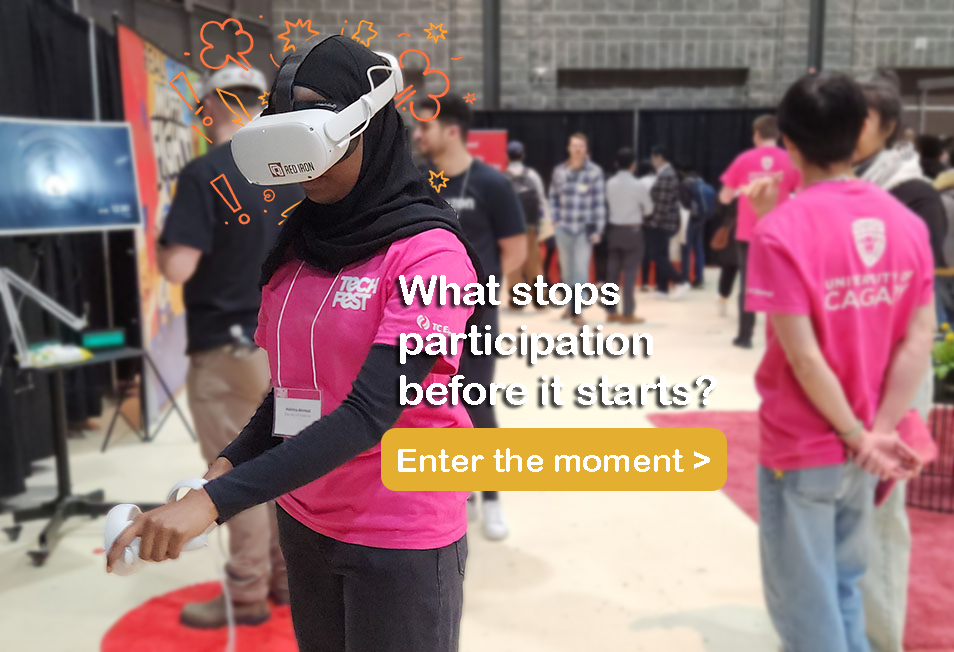
The Moment Before Play At a university tech festival, Fatima—a 19-year-old volunteer—was surrounded by employers, recruiters, and innovation leaders. She was exactly where young adults are told they should be. And yet, she hesitated. “I don’t want to look dumb in front of them”, she confided to me. This wasn’t a lack of ability.It was the same hesitation most of us feel when we’re told to “just network”—only with higher stakes and less experience to lean on. Uncertainty.Self-consciousness.Fear of public failure. This is where learning either shuts down—or begins. The Learning Loop at Work At Third Bell Studio, we study how learning unfolds in the moment, not just in outcomes. When Fatima was invited to play a short round of a collaborative game, her hesitation surfaced immediately. Her body language changed. She verbalized doubt. She weighed the social risk. This is the threshold before participation: Uncertainty → Hesitation → Choice What mattered wasn’t the game itself—it was what the experience allowed her nervous system to feel: Within minutes, her posture softened. She laughed. She adapted. She took initiative. The participation loop took over: Uncertainty → Try → Feedback → Adjust → Re-Entry What Changed After Play After the game ended, something subtle but important shifted. Fatima began approaching employers—using her role as a volunteer to start conversations. Not perfectly. Not with rehearsed confidence. But willingly. The pressure had already dropped, so the conversation no longer felt like a performance. She didn’t become “confident” overnight.She practiced self-advocacy once—safely. And that was enough to make participation feel possible again. Why This Matters We often treat social-emotional skills as things that must be taught explicitly. In practice, they are learned through experience. Play creates conditions where learners can: This is true for young children—and for young adults. It’s even true for adult-adults, like me. Learning doesn’t disappear with age.It just becomes more emotionally expensive. The Third Bell Insight This moment wasn’t about gaming. It was about lowering the cost of re-entry into participation. Play works because it: When learners feel safe enough to try, learning continues. This is the heart of Third Bell Studio:designing environments where people can re-enter learning—again and again. What This Case Shows This moment offers a clear view of how play supports emotional regulation, communication, and agency across ages. Not through instruction.Through experience. Because learning isn’t a straight line.It’s a loop. And every loop begins with permission to try.
Read More
Chaos to Connection
For more than ten years, my work has lived between two worlds:game development and education. I kept returning to learning spaces not because games were a novelty—but because, under pressure, they did something nothing else did. They brought people back in. The Moment It Clicked During the development of Muffin Fight, I watched players do something unexpected. They failed — publicly.They laughed — immediately.They tried again — without prompting. In classrooms and workshops, those same moments usually triggered withdrawal.In the game, they triggered re-entry. That contrast became impossible to ignore. I wrote about that turning point in detail in the article “Chaos to Connection: The Story Behind Muffin Fight 2.0”, but the insight underneath it was simpler than the product itself. The Pattern Beneath the Product Across schools, workplaces, and community programs, learning didn’t break because people lacked ability. It broke when participation became emotionally expensive. Mistakes carried social cost.Silence felt safer than trying.Re-entry required courage most systems didn’t support. Games didn’t remove difficulty.They changed the cost of trying again. What Play Revealed In play, failure is expected.Feedback is immediate.Retry is normal. The medium wasn’t the message.The structure was. Over years of observation, I saw the same loop repeat: Uncertainty → Try → Feedback → Adjust → Re-Entry That loop restored agency faster than instruction ever could. Why Third Bell Studio Exists Third Bell Studio exists to study and design for that structure. We focus on: This work isn’t about games. It’s about what allows learning to restart. Next: a real-world learning moment that shows this loop in action.
Read More
About the Founder
I design playful learning systems that help people re-enter learning when it gets hard. For more than ten years, my work has lived at the intersection of game development, learning, and human behavior. I didn’t arrive here because games were novel—but because, under pressure, they consistently did something other systems didn’t. They brought people back in. Across classrooms, workplaces, and training environments, I kept seeing the same pattern: learning didn’t fail because people didn’t care. It failed because the cost of re-entry was too high. Frustration accumulated. Feedback came too late. Confidence eroded. Participation dropped. Games—especially well-designed ones—handled this differently. They assumed disruption. They built in retry. They made feedback immediate and failure survivable. And in doing so, they quietly taught skills most learning systems struggle to support: resilience, emotional regulation, collaboration, and persistence. That observation sits at the center of my work. How I Came to This Work When I was eight, I played Super Mario for the first time at a neighbor’s house. I didn’t understand two-player mode, so while someone else was actually controlling the character, I was smashing buttons—convinced I was the one landing every jump. When the older kids explained what was really happening, I felt that flash of embarrassment. Then we laughed. They showed me how it worked. I tried again. That moment contains a simple but powerful pattern: try → feedback → adjust. Kids run that loop constantly through play, long before anyone calls it a “skill.” At the time, I didn’t have language for it—but I’ve been following that pattern ever since. Years later, when I first tried to lead others professionally, I realized I didn’t know how. It wasn’t great—for me or for the people around me. That experience pushed me inward and into leadership work grounded in emotional intelligence, where I learned something that stuck: growth isn’t about control or perfection. It’s about practice. Not memorization. Not willpower. Practice. The same loop kids rehearse in play. What I’ve Been Building I’m the co-founder and CEO of Red Iron Labs, where for the past decade I’ve led the design of game-based learning experiences for universities, fire departments, and global organizations. Our work uses play, story, and interaction to help people learn faster, collaborate better, and perform under pressure. One of our virtual reality games, Muffin Fight, made this especially clear. Players failed, laughed, retried, and encouraged each other—practicing resilience, empathy, and teamwork without being instructed to do so. The learning wasn’t abstract. It was embodied. Over time, I came to understand why this worked. Effective learning through play blends three forces: Loops—the rhythm of trying, receiving feedback, adjusting, and continuing—are where real learning consolidates. They make growth feel possible again. What I’m Exploring Now Through Third Bell Studio, I focus on learning recovery and re-engagement: designing systems that make it easier to try again after disruption. My work looks at how emotional engagement shapes behavior, how play supports regulation and confidence, and how learning environments—at home, in schools, and in organizations—can be designed for recovery, not just first attempts. I’m especially interested in making complex ideas about learning feel clear, usable, and grounded in real life—for parents, educators, and teams who want practical tools rather than theory alone. I’m currently exploring research and practice partnerships in school well-being, while continuing to build interactive learning systems rooted in play, feedback, and intentional re-entry. Why This Matters Learning isn’t a straight line.It’s a loop. And every loop begins with permission to try. If you’re curious about how play, story, and interaction quietly build real skills—especially when motivation drops or systems break—you’re in the right place.Hello test wording #3
Read More
About Third Bell Studio
Learning Recovery, Re-Engagement, and Learning Through Play. Most learning doesn’t fail because people don’t care.It fails because the system breaks. A child gets frustrated.A learner disengages.A group loses rhythm.A restart feels heavier than it should. What often looks like “lack of motivation” is something else entirely:the cost of re-entry is too high. Third Bell Studio exists to design learning systems that make retry possible — using learning through play, feedback loops, and intentional re-engagement. The Learning Problem We’re Actually Solving Across homes, classrooms, and organizations, the same learning pattern appears: This is not a discipline problem.It is not a willpower problem. It is a learning recovery problem — a failure of systems to support people after disruption. Most learning environments are designed for first attempts, not for recovery and re-engagement. Why Learning Through Play Works Play is one of the few environments where: In games, mistakes are information — not judgment. Players try, receive feedback, adjust, and try again.This feedback loop is foundational to how humans learn, not just how children play. Learning through play works because it lowers the emotional cost of re-entry. We use play not because it’s cute, but because it is structurally effective. What “Third Bell” Means in Learning Systems The first bell tells you to start.The second bell tells you to move on. The third bell is the one that gives you a way back —after disruption, frustration, or disengagement. Third Bell Studio designs learning systems for that third moment: That is where learning either restarts — or disappears. Where This Learning Recovery Insight Came From This work didn’t begin as a theory. It emerged through work developed at Red Iron Labs, a game and simulation studio that has spent nearly a decade building interactive systems across education, healthcare, and entertainment. That environment functioned as a laboratory — a place where learning, engagement, and failure could be observed repeatedly across different contexts. We kept encountering the same moment:not the start of learning,not mastery,but the moment after disruption. In some systems, learners re-engaged quickly when feedback was immediate and non-judgmental.In others, disengagement lasted days when feedback was delayed or emotionally costly.Groups with low-cost re-entry regained momentum faster than groups with perfect instructions. Different contexts.Same underlying failure. Learning systems were optimized for starting — not for coming back. One project in particular made this impossible to ignore and will be documented as a formal case study. What was designed as playful chaos became an unexpected space for learning recovery: collaboration after mistakes, laughter after frustration, and retry without shame. That observation reshaped the work. Third Bell Studio exists to abstract those insights into a focused learning recovery model that can travel beyond any single game or platform. The core question became: What makes retry feel safe inside a learning system? Third Bell Studio exists to answer that question. What We Build Third Bell Studio develops: All of our work is built around learning recovery, re-engagement, and retry. Sometimes that looks like a simple tool.Sometimes it looks like a full system redesign. The structure underneath is always the same. Who Third Bell Studio Is For Third Bell Studio works with: If your work involves humans, disruption, and re-entry, this work applies. Our Perspective on Learning and Engagement We do not believe learning is linear.We do not believe motivation is the core issue.We do not believe pressure improves outcomes. We believe: Learning works when retry is safe. Where This Is Going Third Bell Studio is building a growing library of learning recovery tools and engagement frameworks that can live in: Some outputs will be playful.Some will be technical. All of them are designed to answer the same question: How do we help people come back after learning breaks down?
Read More
Welcome to Third Bell Studio
Learning doesn’t fail because people don’t care. It fails because the system breaks. A child gets frustrated. A learner disengages. A group loses rhythm. Third Bell Studio designs learning systems for re-entry.
Read More